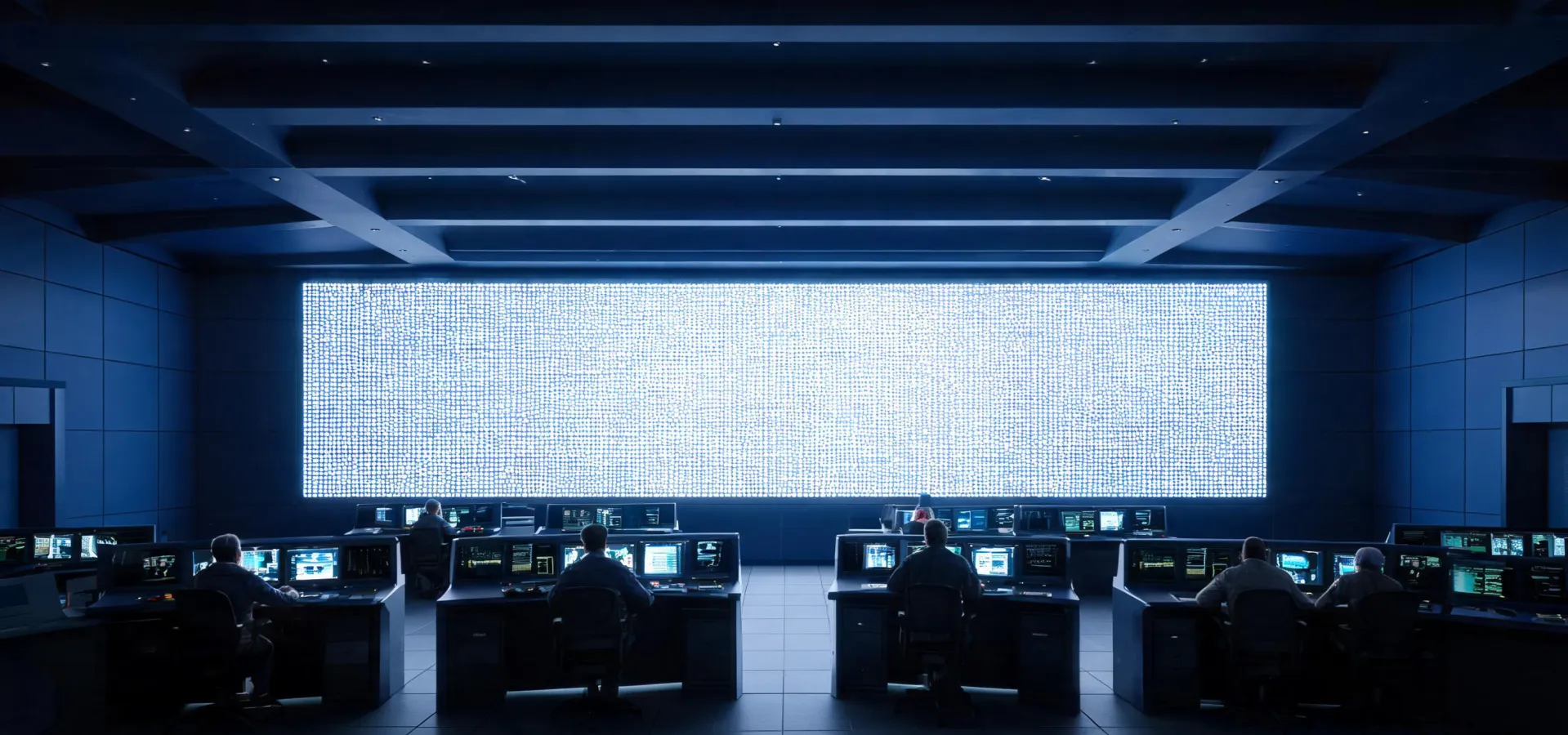
Absen LED video wall in a mission-critical control room
Professional LED Display Systems

Absen LED video walls engineered around the viewing task

Plan pixel pitch, brightness, cabinet access and signal redundancy as one operating system—from the first sightline study through on-site calibration.

Design Inputs

Four decisions shape the display before a cabinet is selected

A useful specification begins with the audience, ambient light, duty cycle and service path—not a model number.

01

Pixel pitch by sightline

Map the nearest and typical viewing distances before resolving module geometry.
02

Luminance by environment

Set a calibrated operating target for indoor, window-facing or outdoor light conditions.

03

Access by architecture

Choose front or rear service access against wall depth, lift access and maintenance windows.

04

Redundancy by consequence

Define signal and power recovery paths according to acceptable interruption time.

Specification Tabs

Translate the application brief into testable acceptance criteria

The values below are planning ranges, not universal product claims. Final limits belong in the approved series datasheet and project submittal.
Pixel pitchResolve from nearest viewing distance and content detail; verify the native canvas map.
BrightnessRecord calibrated white luminance in nits under the expected ambient-light condition.
Refresh behaviorCheck scan artifacts with the intended camera shutter speeds when broadcast capture is in scope.
Power pathDocument feed capacity, branch protection, heat load and the required recovery arrangement.
Signal pathTest primary and backup sources, switchover behavior and controller recovery.
Service accessConfirm module extraction clearance and replacement sequence in the built opening.
UniformityMeasure multiple screen zones after warm-up and calibration, then archive the baseline.
Content testRun native-resolution gradients, low-gray fields, motion and representative operator content.
HandoverDeliver configuration backups, spare-part locations and a named escalation route.
Project Evidence

Absen project teams work from recorded checkpoints

Instead of relying on promotional superlatives, the handover record tracks the conditions a team can inspect again.

4baseline image fields
2signal paths checked when specified
°C1stabilized warm-up condition
1signed acceptance record
Start With Constraints

Send the room geometry before asking for a screen size

Absen project intake is more useful when it includes the nearest viewer, available wall depth, ambient light, content resolution and operating hours.

  • Application and audience map
  • Active image dimensions or architectural opening
  • Front/rear access limitation
  • Power, signal and redundancy requirement

Project intake

Share the known constraints; unknown fields can be resolved during engineering review.

Please enter your name.
Please enter a valid email.
Tell us about the intended viewing distance, environment and display size.